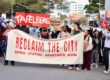
Thozama Angela Adonisi, the first applicant, expressed her joy at the outcome:
Nkosikhona Swartbooi, a former Reclaim the City Leader, spoke on the symbolic weight of the victory:
-
“This victory for me reminded me of an analogy of Isi Vivana. It is the coming together of all the contributions that we’ve all contributed to in ensuring that we fight for a more just and equal society, a city that’s less divided, but a city that is united, where houses are built to bridge the divides in our society.”
Sheila Madikane, a resident of Ahmed Kathrada House (formerly Helen Bowden Nurses’ Home) and a founding leader of Reclaim the City, reflected on the personal impact:
-
“I wish that each and every land can come like this. Today, as Reclaim the City, we did show our government in South Africa that this is what people need and this is what people are supposed to get. We are still going to carry on to fight for land and to fight for justice so that people have also a safe home and have their own rights where they can stay proper.”
Disha Govender, former Head of the Ndifuna Ukwazi Law Centre and co-lead attorney on the matter, highlighted the judgment’s broader significance:
-
“There are simply no words to express the joy, absolute joy, at the moment. The judgment does not only usher in change for the city and the province, but the court’s findings that talk about how land is to be used, managed, and disposed of, and how people must be involved in the decision-making will mean change for this country.”
Buhle Booi, Head of Political Organising and Campaigns at Ndifuna Ukwazi, underscored the judgment as a victory for the working class and a rebuke to government’s approach to public land:
-
“Today, as an organization, and Reclaim the City, I’m happy that the judgment, the long-awaited judgment of Tafelberg is out. We’re happy because the judgment vindicates us as a movement and the organization that we’ve been saying for a very long time that the Western Cape Government and the municipality have an obligation to redress spatial apartheid. This is a victory for the domestic workers of Sea Point. This is a victory for the working-class people of the city and the working-class people across the country. This is a landmark judgment that will tell governments across the country and municipalities that public land is not something to be sold. It should not be viewed as a mere commodity. It must first be prioritised for its social value. It must be used to address inequalities and the harsh realities of our past.”